There’s something magical about the Italian language. Whether you’re dreaming of ordering authentic carbonara in Rome, understanding opera lyrics, or connecting with your Italian heritage, learning this foreign language opens doors to one of the world’s richest cultures. But with countless apps, textbooks, online courses, and language schools available, finding the best way to learn Italian can feel overwhelming.
The truth is, not all learning methods deliver equal results. While some approaches take years to develop conversational fluency, others can teach you to learn Italian fast and have you confidently speaking in months. This guide breaks down what actually works, based on language acquisition research and the experiences of successful learners who’ve mastered this beautiful foreign language.
Why Traditional Methods Often Fall Short
Before exploring the most effective approaches, it’s worth understanding why many Italian learners struggle despite their best efforts.
The App Trap: Gamification Without Real Conversation
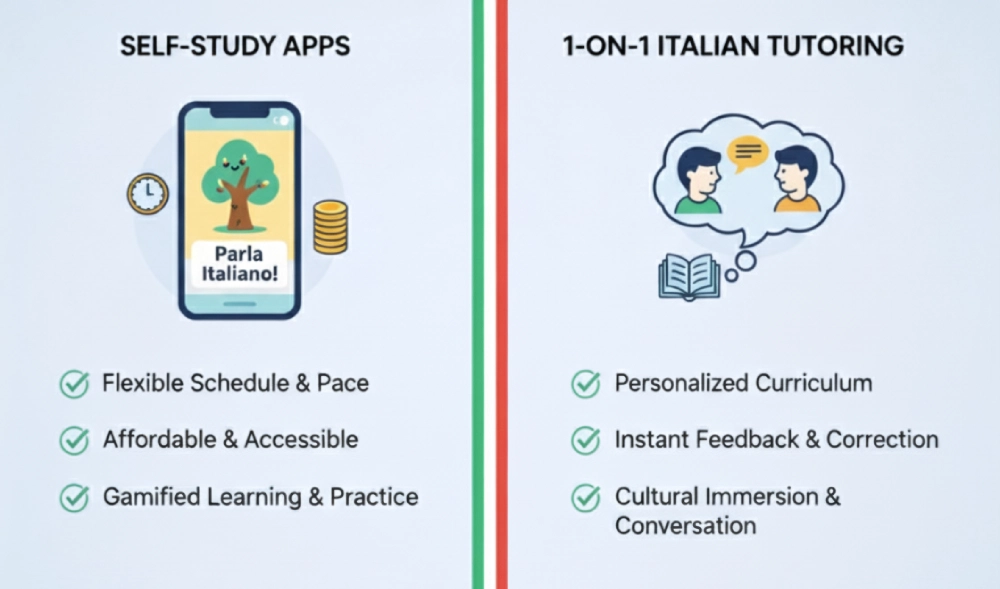
Language apps like Duolingo have made learning more accessible and entertaining. These free apps with gamification elements keep you engaged, and completing daily lessons at your own pace feels productive. However, most learners discover a frustrating gap between app proficiency and real-world communication.
You might excel at matching Italian vocabulary to pictures or completing grammar exercises, yet freeze when trying to have an actual conversation with a native speaker. This happens because apps primarily develop reading and listening comprehension while providing limited speaking practice. Without regular conversation, you miss the immediate feedback, Italian pronunciation correction, and cultural context that transform textbook knowledge into practical language skills.
The Grammar Grind: When Rules Overshadow Communication
Traditional textbook methods take a different approach, emphasizing grammar rules and verb conjugations from day one. While understanding sentence structure matters, getting stuck in analysis paralysis prevents many learners from progressing.
When you focus exclusively on perfect grammar before speaking, you delay the most important skill: actual communication. Language learners often spend months memorizing verb tenses and rules without developing the confidence to speak, which ultimately slows the entire learning process.
The Consistency Challenge
Perhaps the biggest obstacle isn’t the method itself but maintaining consistent practice. Self-study with language courses or a grammar book requires remarkable discipline. Without accountability, it’s easy to skip practice sessions when life gets busy. Motivation fades when progress feels slow, and many abandon their Italian studies within weeks. No one wants to feel like they’re wasting time on learning languages that don’t progress.
How Adults Actually Learn Languages

Understanding how the brain acquires new languages helps explain why certain methods work better than others.
Research in second language acquisition shows that adults learn most effectively through comprehensible input combined with active output. In simpler terms, you need exposure to Italian that’s just slightly above your current level, paired with regular opportunities to speak and use the language yourself.
Immediate error correction is crucial to this process. When someone corrects your pronunciation or grammar in real-time during conversation, your brain forms stronger connections than when you discover mistakes later through app notifications or textbook answer keys.
Personalization also matters significantly. Everyone has different learning goals, whether that’s travel conversation, business Italian, or discussing literature. Your native language, learning style, pace preferences, and starting point are unique. Generic one-size-fits-all curricula from traditional Italian language schools can’t adapt to these individual needs the way personalized instruction can.
Finally, the emotional component of learning is often overlooked. Language acquisition isn’t purely cognitive. Encouragement, emotional support, and human connection keep learners motivated through the inevitable frustrations and plateaus. This is perhaps the most important distinction between effective learning and mere exposure.
The Most Effective Way to Learn Italian
After reviewing language-learning research and analyzing what successful Italian speakers have in common, one approach consistently delivers the fastest results: one-on-one instruction with experienced, native-speaking Italian teachers.
Why This Method Works
When you work with a dedicated Italian tutor, you get personalized lesson plans built around your specific goals and current level. Rather than following a predetermined curriculum like in a traditional Italian class, your tutor assesses where you are and creates a learning path that makes sense for you.
Speaking practice begins immediately, even for complete beginners learning the Italian alphabet for the first time. From your very first lesson, you’re forming Italian sentences and having real conversations, even if they’re simple. This builds practical communication skills from day one rather than spending months on preparation before attempting to speak.
The value of immediate feedback cannot be overstated. When you mispronounce a word or make a grammatical error during conversation, your tutor corrects you instantly. Your brain processes this real-time correction more effectively than reviewing mistakes later. Native speakers also catch subtle Italian pronunciation issues that automated systems miss entirely.
Beyond mechanics, you gain cultural context that transforms language learning. Italian tutors share idioms, cultural references, and real-world usage that no app can teach. They explain why Italians say things in certain ways and help you understand the cultural nuances behind the language.
Perhaps most importantly, working with a tutor creates accountability. When you have scheduled lessons with someone invested in your progress, you’re far more likely to practice consistently and stay committed to your goals.
What Makes Personalized Instruction Different
The beauty of one-on-one tutoring lies in its adaptability. If you’re learning Italian for an upcoming trip to Florence, your tutor focuses on practical travel phrases, everyday situations, and even helps you practice with an Italian phrasebook. If you need Italian for business, lessons center on professional vocabulary and formal communication.
Your tutor also adapts to how you learn best using various teaching methods. Some students thrive with structured grammar explanations, while others prefer conversational immersion. Visual learners benefit from charts and diagrams, while auditory learners excel with listening exercises and audio courses. Personalized instruction adapts to your learning style rather than forcing you into a rigid format.
The pace adjusts to your schedule and absorption rate. If you grasp the present tense quickly, you move forward. If verb conjugations need more time, you spend extra lessons mastering them. There’s no pressure to keep up with a class, and no frustration at being held back by a predetermined curriculum.
For students seeking this level of personalized attention, working with an Italian tutor who can tailor each lesson to your needs offers significant advantages over generic programs. Many platforms also offer a free trial lesson, allowing you to experience online lessons firsthand before committing.
Complementary Strategies That Accelerate Learning
While one-on-one instruction forms the foundation of effective Italian learning, several complementary strategies amplify your progress between lessons. The good news is that many of these resources are either free or low-cost, making them accessible to everyone.
Immersion Techniques for Daily Practice
Surrounding yourself with Italian throughout your day accelerates language acquisition remarkably. This is truly a great way to reinforce what you’re learning in lessons. Start by listening to Italian podcasts during your commute. Programs like Coffee Break Italian and Easy Italian provide excellent listening comprehension practice at various levels, functioning almost like an audio course you can enjoy anywhere.
Switch your phone’s language settings to Italian. This forces you to recognize common words and phrases dozens of times a day in your daily life. Similarly, follow Italian social media accounts related to your interests, whether that’s cooking, football, or fashion. This naturally and consistently exposes you to Italian content.
Watching Italian TV shows and movies with Italian subtitles helps tremendously. Many learners make the mistake of using English subtitles, but Italian subtitles work better because they reinforce the connection between what you’re hearing and reading in the target language. Popular TV series on streaming platforms offer an easy and fun way to improve comprehension skills. YouTube videos from Italian creators provide another excellent source of authentic content at the intermediate level and beyond.
Smart Vocabulary Building
Rather than memorizing random word lists, focus on the most common words in Italian first. Research shows that the 1,000 most frequent words account for roughly 80% of everyday conversation. Your tutor can guide you toward high-value vocabulary for your specific goals, ensuring you learn new words that matter most.
Flashcard apps using spaced repetition systems help retain new vocabulary. Apps like Anki schedule reviews at optimal intervals to move words from short-term to long-term memory. Create cards with example sentences rather than isolated words to learn vocabulary in context.
Reading Italian news from sources like La Repubblica or Corriere della Sera helps intermediate learners stay current while improving reading skills. For beginners, short stories written for language learners provide a gentle introduction to reading practice. These resources help you encounter new words in context, which aids retention far better than isolated vocabulary lists.
Grammar in Context
Instead of memorizing grammar rules abstractly, learn them through conversation and real examples. When your tutor explains present tense conjugations by having you describe your daily routine, the patterns stick better than textbook charts alone.
Focus on mastering one verb tense thoroughly before moving to the next. Many learners try to learn all tenses simultaneously and end up confusing them. Building a solid foundation with the present tense before progressing to past and future tenses creates a clearer understanding.
Realistic Timeline: How Long Does It Take to Learn Italian?
One of the most common questions Italian learners ask is how long it takes to learn Italian and what amount of time the journey to fluency requires.
The answer depends significantly on your chosen method and practice frequency. Self-study using only apps typically takes two to three years to reach conversational ability, assuming consistent daily practice. This isn’t the only way to learn, but it’s one of the slower paths. Many learners discover that gaps in their speaking skills remain even after years of app use.
Traditional classroom courses with once-weekly group lessons generally require 18 months to two years for basic conversational fluency. Progress depends heavily on class size, teacher quality, and consistent attendance.
With focused one-on-one tutoring, meeting two to three times weekly, most dedicated learners reach conversational fluency in six to nine months. This accelerated timeline results from personalized instruction, regular speaking practice, immediate feedback, and consistent accountability.
Several factors influence your individual timeline. If you speak another Romance language, such as Spanish or French, you’ll progress faster due to shared vocabulary and grammar. Your language experience from high school or previous studies also helps, as you’ve already developed effective study strategies.
Practice frequency matters more than practice duration. Three 30-minute sessions weekly deliver better results than one three-hour weekend session. Consistent exposure helps your brain process and retain new information more effectively.
Your specific goals also affect timeline expectations. Achieving tourist-level Italian for vacation conversation takes less time than business fluency or the ability to read Italian literature.
Common Mistakes to Avoid
Learning from others’ missteps can save you significant time and frustration.
Prioritizing Reading Over Speaking Too Early
Many Italian learners spend months building reading and writing skills before attempting conversation. While reading comprehension has value, delaying speaking practice severely limits your progress.
Speaking should begin immediately, even with a vocabulary of just 50 words. Your tutor creates a safe environment for making mistakes and helps you build confidence from the start. Waiting until you feel "ready" means that moment may never come.
Perfectionism Paralysis
Fear of making mistakes prevents many English speakers from practicing Italian. You worry about embarrassing yourself or saying something incorrectly.
Remember that every successful Italian speaker made countless errors during their learning journey. Native Italian speakers appreciate your efforts to learn their beautiful language and rarely judge mistakes harshly. Your tutor’s role includes creating a judgment-free space where errors become learning opportunities rather than sources of shame.
Embrace "good enough" communication, especially early on. Conveying your meaning matters more than perfect grammar. Fluency develops through practice, not through waiting until you’re perfect.
Neglecting Listening Comprehension
Some learners focus heavily on speaking while neglecting listening and overall comprehension. However, real conversations require understanding native speakers at natural speed, complete with regional accents and colloquialisms.
Dedicate time to listening practice through Italian podcasts, news broadcasts, and conversations. This develops your ear for the language’s rhythm, pronunciation, and natural speech patterns. Your tutor can provide targeted listening exercises that match your level.
Inconsistent Practice
Perhaps the most common mistake is irregular practice. Studying intensively for a week, then taking two weeks off, severely hampers progress. Your brain needs consistent exposure to move Italian from short-term to long-term memory.
Schedule regular lessons and stick to them like important appointments. The accountability of working with a tutor helps maintain this consistency even when motivation temporarily wanes.
Making Your Decision: Taking the First Step
Learning Italian represents an investment in yourself, your career opportunities, travel experiences, and cultural connections. There are good ways to approach this journey, but the method you choose significantly impacts both your timeline and ultimate success.
While apps and self-study materials offer convenient starting points, they cannot replace the personalized guidance, real-time feedback, and human connection that accelerate language acquisition. One-on-one instruction with experienced native speakers addresses the fundamental requirement of language learning: authentic communication practice with immediate error correction.
The path forward begins with a single conversation. Consider exploring Italian tutoring options that offer personalized instruction. Many platforms offer trial lessons, letting you assess whether this approach fits your learning style and goals before committing.
Your Italian journey doesn’t require perfection from day one. It requires starting, maintaining consistency, embracing mistakes as learning opportunities, and working with someone who can guide your progress. The fastest route to speaking Italian confidently isn’t necessarily the easiest, but it’s the one that puts communication at the center from the very beginning.
Six months from now, you could be ordering confidently in Italian restaurants, understanding Italian films without subtitles, and having genuine conversations with native speakers. The best way to learn Italian is the one you’ll actually stick with, and nothing creates accountability and accelerates progress quite like having a dedicated tutor invested in your success.